
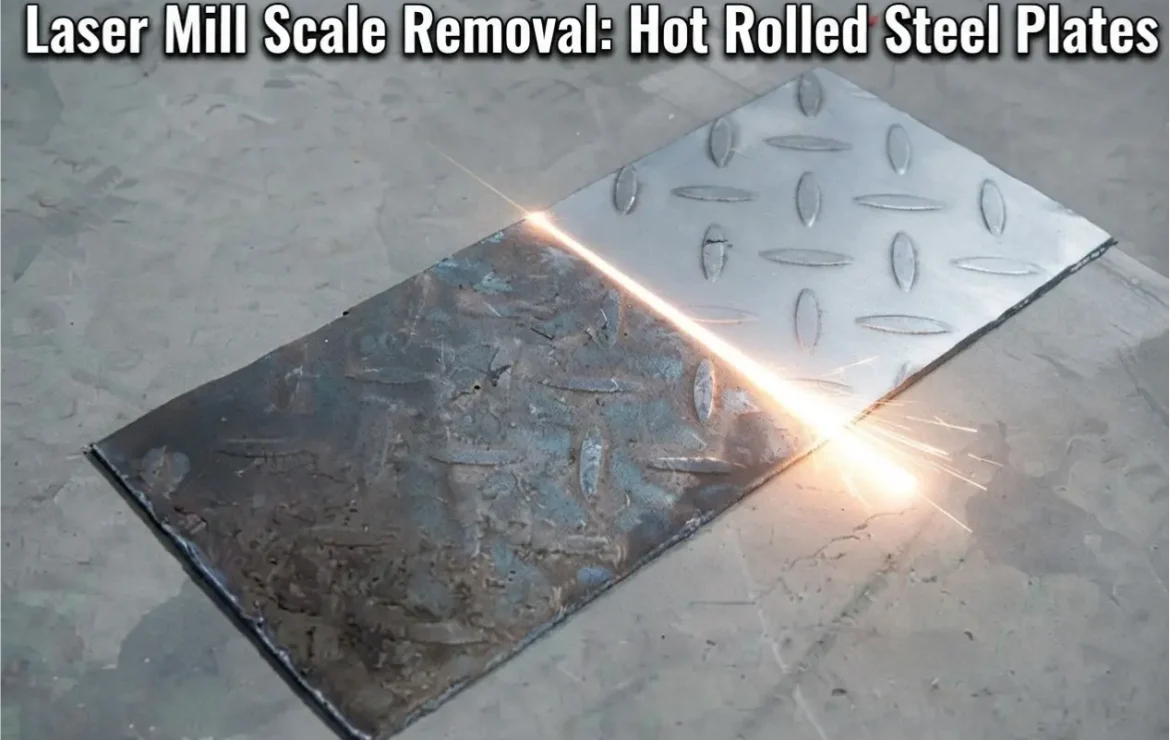
Mill Scale Removal: How to Remove Mill Scale from Steel
Mill scale is one of the most common surface contaminants found on hot-rolled steel. It forms during high-temperature manufacturing when iron reacts with oxygen and creates a hard layer of iron oxides on the steel surface.
Although mill scale can look like a thin, stable coating, it can become a serious problem when steel needs to be welded, painted, coated, inspected, or further processed.
Traditional mill scale removal methods include grinding, abrasive blasting, wire brushing, and chemical pickling. These methods can work, but they may also create dust, abrasive waste, chemical waste, high labor requirements, or unnecessary material removal.
Laser mill scale removal provides another approach. By using controlled laser energy to break down and remove the oxide layer, industrial laser cleaning systems can prepare steel surfaces without direct mechanical contact.
This guide explains how mill scale forms, how to remove it, when laser cleaning makes sense, what laser power may be required, and how to select a mill scale removal machine for industrial applications.
What Is Mill Scale?
Mill scale is a layer of iron oxide that forms on the surface of steel during hot rolling and other high-temperature manufacturing processes.
It is not simply ordinary rust.
Mill scale typically contains several iron oxide phases, including:
- Wüstite
- Magnetite
- Hematite
The exact structure and thickness depend on the steel grade, processing temperature, cooling conditions, and manufacturing process.
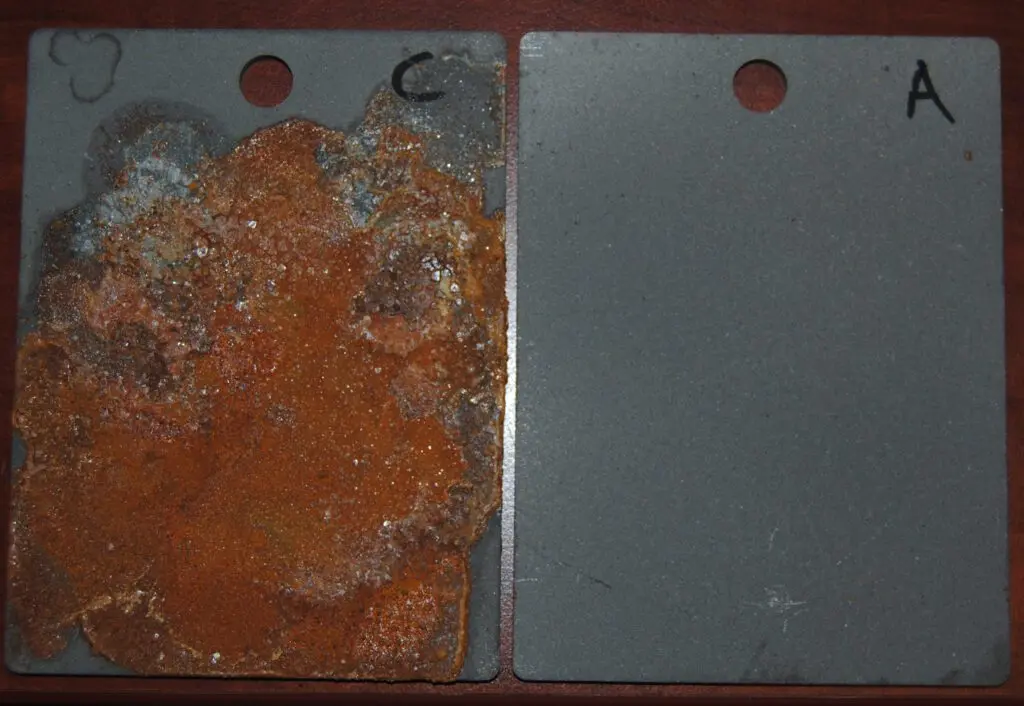
Fresh mill scale can form a relatively dense and strongly bonded layer. As the steel is stored or exposed to moisture, cracks can develop in the scale, allowing corrosion to begin underneath or around it.
This creates a surface that may contain a combination of:
steel → mill scale → corrosion → contamination
For many fabrication and coating operations, removing the scale is necessary before the next manufacturing step.
Why Does Mill Scale Need to Be Removed?
Whether mill scale must be removed depends on the application.
For some basic fabrication operations, mill scale may remain on the steel temporarily. However, removing it becomes important when surface condition affects welding, coating adhesion, inspection, dimensional accuracy, or corrosion protection.
1. Before Welding
Mill scale can interfere with welding when it is present in the weld zone.
Depending on the welding process and material condition, surface contamination can contribute to:
- Poor weld consistency
- Surface contamination
- Porosity or inclusions
- Unstable arc conditions
- Increased post-weld cleaning
For critical weld preparation, removing the scale from the intended weld area can provide a cleaner and more predictable surface.
2. Before Painting
Paint and protective coatings require an appropriately prepared substrate.
If loosely bonded mill scale remains underneath the coating, the coating system may eventually fail when the scale separates from the steel.
This is particularly important for:
- Structural steel
- Bridges
- Heavy equipment
- Steel frames
- Storage tanks
- Pipes
- Marine structures
3. Before Protective Coatings
Mill scale can also affect bonding between steel and specialized coatings.
When the coating system depends on direct contact with the steel substrate, removing unstable oxide layers can improve surface preparation consistency.
4. During Inspection
Mill scale and corrosion can hide the actual condition of the steel.
Removing the surface layer can make it easier to inspect:
- Pitting
- Cracks
- Corrosion
- Weld areas
- Surface defects
- Localized damage
How to Remove Mill Scale from Steel
There are several common methods for mill scale removal.
The appropriate method depends on the steel geometry, scale thickness, required surface condition, production volume, and environmental requirements.
1. Grinding
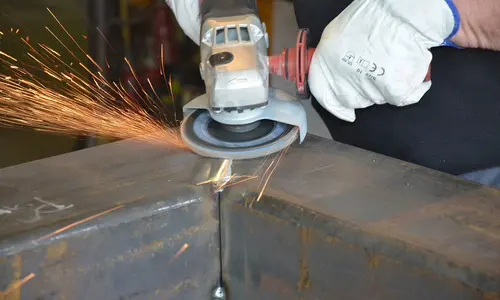
Grinding is one of the most common mechanical methods.
An operator uses an abrasive wheel, disc, or belt to physically remove the scale.
Advantages
- Simple equipment
- Widely available
- Effective on localized areas
- Suitable for weld preparation
Limitations
Grinding can be labor-intensive when large areas must be cleaned.
It can also:
- Generate dust
- Consume abrasive discs
- Remove some base material
- Create an inconsistent surface if manually operated
- Produce significant operator fatigue
For small repair areas, grinding may remain practical. For large steel surfaces, however, productivity becomes a major consideration.
2. Abrasive Blasting
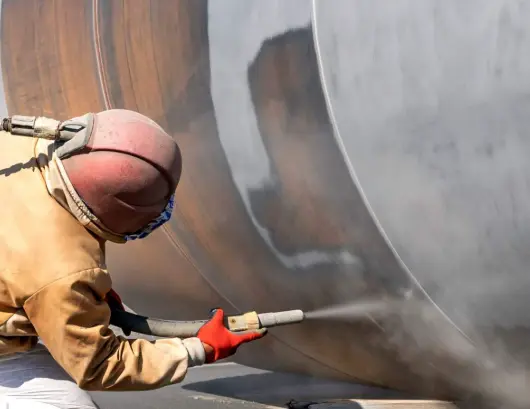
Abrasive blasting uses media such as steel shot, grit, or other abrasives to remove mill scale and surface contamination.
It is widely used in steel fabrication and industrial surface preparation.
Advantages
- High productivity
- Suitable for large surfaces
- Well-established industrial process
- Can provide a controlled surface profile
Limitations
Abrasive blasting also introduces additional process requirements.
These may include:
- Abrasive media consumption
- Dust control
- Containment
- Media recovery
- Waste handling
- Worker protection
- Surface cleanup
For large steel structures, these secondary operations can represent a significant part of the total cleaning process.
3. Chemical Pickling
Chemical treatment can dissolve oxide layers from steel surfaces.
Pickling is used in many industrial metal-processing applications, particularly where large volumes of steel require chemical surface treatment.
However, chemical cleaning requires careful control of:
- Chemical concentration
- Temperature
- Treatment time
- Rinsing
- Wastewater
- Chemical storage
- Worker protection
It is therefore better suited to controlled industrial processes than many field-maintenance applications.
4. Laser Mill Scale Removal
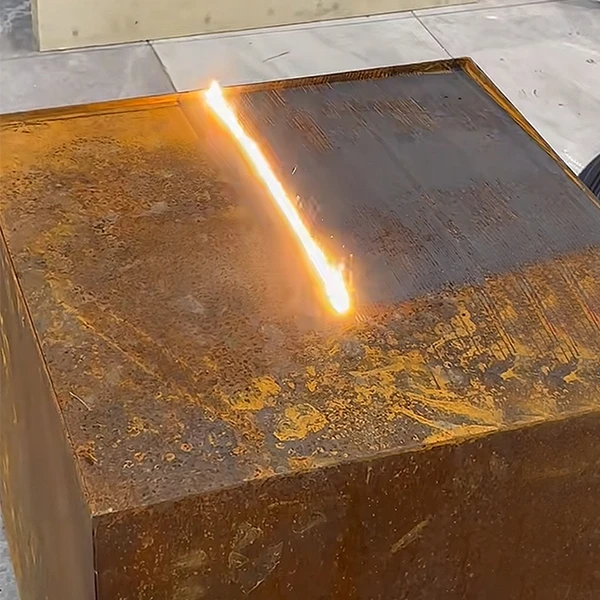
Laser cleaning removes mill scale by directing controlled laser energy onto the contaminated surface.
The objective is to remove the oxide layer while keeping the underlying steel within an acceptable thermal and surface condition.
The process is non-contact.
There is no grinding wheel physically touching the steel, and there is no abrasive media being projected against the surface.
A typical laser cleaning process involves:
- Positioning the laser cleaning head over the steel.
- Selecting an appropriate laser power and cleaning mode.
- Adjusting scanning speed.
- Selecting scan width and pattern.
- Testing the parameters on a representative area.
- Removing the mill scale through one or more passes.
- Inspecting the cleaned surface.
The actual cleaning performance depends strongly on the scale condition and laser parameters.
Laser Mill Scale Removal: How It Works
Laser cleaning is based on the interaction between laser energy and the surface contamination.
The mill scale absorbs laser energy differently from the underlying steel. With properly selected parameters, the oxide layer can be broken down and removed while limiting unwanted effects on the substrate.
The key variables include:
- Laser power
- Pulse duration
- Pulse frequency
- Energy density
- Scanning speed
- Scan width
- Focal position
- Number of passes
- Beam profile
- Material composition
- Mill scale thickness
This means that laser cleaning is not simply a matter of choosing the highest available wattage.
A higher-power laser can increase productivity, but the optimum settings still depend on the specific steel and scale condition.
Can a Laser Remove Heavy Mill Scale?
Yes, laser cleaning can be used for mill scale, including relatively heavy oxide layers.
However, heavy mill scale requires substantially more energy and process time than a thin oxide film.
This distinction is important when selecting equipment.
A thin oxide layer on a small steel component may be suitable for a lower-power pulsed laser.
A large structural-steel component covered with dense mill scale may require a higher-power system and a larger scan width to achieve acceptable production throughput.
For heavy industrial work, high-power continuous-wave laser cleaning systems can also be considered where sustained energy delivery and high-area productivity are required.
YIHAI’s high-power laser cleaning range includes 1000W–3000W systems intended for heavy-duty metal cleaning, with the 3000W configuration using continuous fiber laser technology and industrial water cooling.
The important point is that power should be selected according to the actual mill scale condition and required production rate, not simply the thickness of the steel itself.
Laser Mill Scale Removal vs Grinding, Blasting and Chemicals
There is no single cleaning method that is ideal for every steel application.
The choice depends on the production environment.
| Method | Main Advantage | Main Limitation | Typical Use |
|---|---|---|---|
| Grinding | Simple and accessible | Labor-intensive and abrasive wear | Small areas, weld zones |
| Wire brushing | Low equipment cost | Limited removal capability | Light contamination |
| Abrasive blasting | High-area productivity | Media, dust and waste | Large steel structures |
| Chemical pickling | Effective oxide removal | Chemical handling and wastewater | Controlled industrial processing |
| Laser cleaning | Non-contact, selective process | Equipment investment and parameter development | Precision and industrial surface preparation |
Laser cleaning is particularly interesting when reducing abrasive consumption, minimizing secondary waste, or cleaning areas where mechanical contact is undesirable is important.
However, abrasive blasting can still be highly productive for very large, uncomplicated steel surfaces.
The correct comparison should therefore consider total process cost, not only cleaning speed.
What Laser Power Is Needed for Mill Scale Removal?
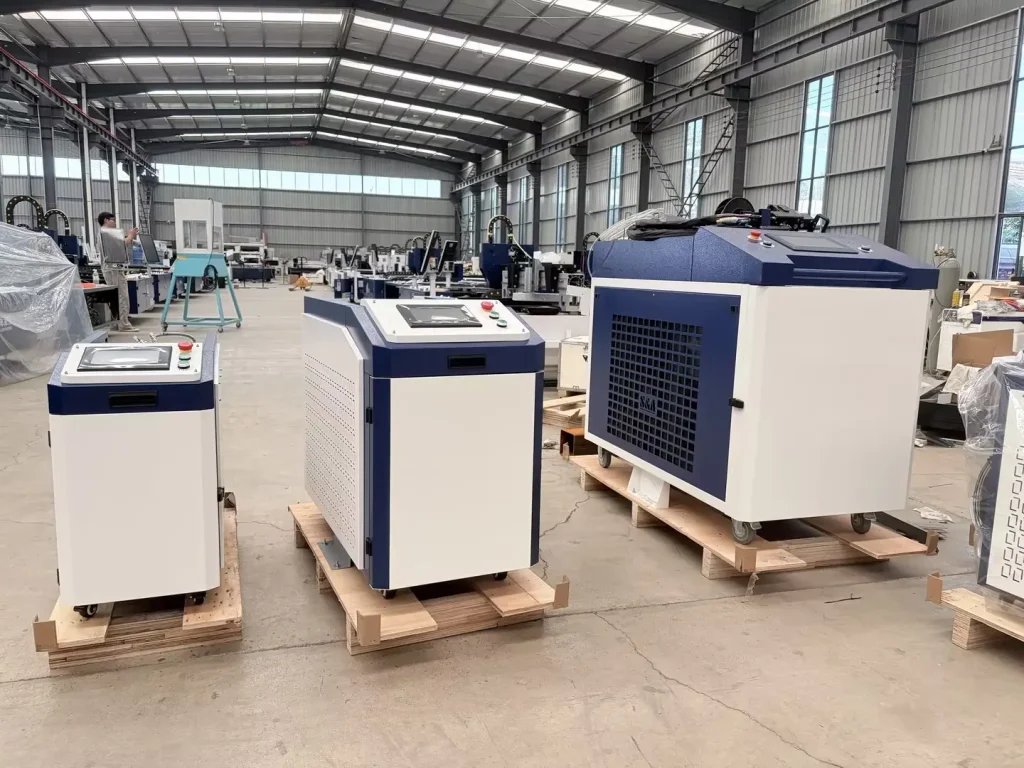
There is no universal laser power for every mill scale application.
The required power depends on:
- Mill scale thickness
- Scale adhesion
- Steel grade
- Surface condition
- Cleaning width
- Required cleanliness
- Production area
- Number of passes
- Desired throughput
As a practical starting point:
| Laser Power Class | Potential Application |
|---|---|
| 200W–300W | Light oxide, localized scale, precision cleaning |
| 500W | Medium-duty steel cleaning and workshop applications |
| 1000W | Industrial steel cleaning and heavier contamination |
| 1500W–2000W | Large-area and heavy-duty steel cleaning |
| 3000W | High-throughput heavy industrial cleaning |
These are application-oriented ranges, not guaranteed mill-scale removal specifications.
The same 1000W machine can produce very different results depending on scanning speed, beam size, pulse settings, scale thickness, and surface condition.
YIHAI’s published power guide similarly positions 200W–300W systems toward precision cleaning and oxide removal, while 1000W and higher systems are intended for progressively heavier industrial cleaning requirements.
For a production purchase, sample testing is more reliable than selecting a machine based only on wattage.
Pulsed vs Continuous-Wave Laser for Mill Scale
One of the most important decisions is whether to use a pulsed or continuous-wave laser.
Pulsed Laser Cleaning
Pulsed lasers deliver energy in short pulses.
They are commonly considered when the application requires:
- Controlled material removal
- Lower overall heat input
- Precision cleaning
- Weld-zone preparation
- Thin or sensitive components
- Localized oxide removal
Pulsed systems can be particularly useful when surface selectivity is more important than maximum area throughput.
Continuous-Wave Laser Cleaning
Continuous-wave (CW) lasers deliver energy continuously.
They can be useful for:
- Large steel surfaces
- Heavy contamination
- Thick oxide
- Large-area cleaning
- High-throughput industrial applications
The continuous energy delivery can provide high productivity on large, robust steel structures.
For example, YIHAI’s 3000W high-power system is a continuous fiber laser with industrial water cooling and a stated scan width of 10–200 mm.
Which One Should You Choose?
A simplified decision framework is:
Precision + thin oxide + smaller components → pulsed laser
Large steel + heavy scale + high production volume → consider high-power CW
This should still be verified through application testing because the optimum process depends on the actual scale.
Mill Scale Removal Before Welding
Welding preparation is one of the most practical applications for mill scale removal.
A steel surface may look clean enough to the eye while still carrying oxide and other contamination.
Laser cleaning can be used to prepare:
- Butt joints
- Lap joints
- Weld seams
- Pipe ends
- Structural steel joints
- Robotic welding zones
- Laser welding areas
For automated manufacturing, the cleaning process can potentially be integrated before the welding operation.
This creates a workflow such as:
Steel component → laser cleaning → inspection → welding → post-weld processing
Instead of manually grinding every weld zone, a dedicated laser cleaning station can provide a repeatable preparation process.
For high-volume manufacturing, the laser can also be integrated with robotic or automated handling systems.
Mill Scale Removal Before Painting and Coating
Mill scale is particularly important when steel will receive a protective coating.
The coating system depends on the condition of the steel surface underneath it.
If unstable scale remains, coating failure can occur when the scale separates from the substrate.
Laser cleaning can therefore be considered as part of a surface-preparation workflow for:
- Structural steel
- Machinery
- Heavy equipment
- Pipes
- Tanks
- Steel frames
- Marine structures
- Industrial components
The final surface requirement should always be defined before cleaning.
For example, removing visible scale is not necessarily equivalent to achieving a specific coating-preparation standard.
If a project requires a particular surface cleanliness or roughness specification, the laser process must be tested against that specification.
What Affects Laser Mill Scale Removal Speed?
Laser cleaning speed can vary significantly from one steel component to another.
The most important variables include:
1. Mill Scale Thickness
A thin oxide film requires less energy than dense, heavily bonded mill scale.
2. Scale Adhesion
Older or cracked scale may behave differently from a dense layer strongly bonded to freshly manufactured steel.
3. Laser Power
Higher average power can increase material-removal capacity, but power alone does not determine productivity.
4. Scanning Speed
Scanning too quickly may leave residual scale.
Scanning too slowly can reduce productivity and increase unnecessary heat input.
5. Scan Width
A larger scan width can cover more area but may change the energy density delivered to the surface.
6. Number of Passes
Some applications can be completed in one pass.
Others require multiple passes to reach the desired surface condition.
7. Beam and Pulse Parameters
Pulse duration, frequency, beam profile, and focal position all affect how energy interacts with the scale.
How Many Passes Are Required?
There is no universal number of passes for mill scale removal.
A thin or weakly bonded layer may be removed in a single pass.
Heavy mill scale may require multiple passes.
Instead of optimizing only for the fewest passes, industrial users should evaluate:
Total cleaning time = scan time + repositioning + inspection + rework
A process that uses two controlled passes may be more productive overall than a single aggressive pass that requires repeated inspection or produces an undesirable surface condition.
Can Laser Cleaning Damage Steel?
Laser cleaning can affect the substrate if the process parameters are poorly selected.
This is why parameter development is essential.
Potential problems include:
- Excessive heat input
- Surface discoloration
- Unwanted material removal
- Surface modification
- Inconsistent cleaning
The risk depends on the material, laser source, energy density, scanning conditions, and required surface result.
The safest approach is to perform a controlled sample test before production.
A useful test procedure is:
Material identification → mill scale assessment → parameter test → visual inspection → surface inspection → production validation
Do not assume that the same laser settings used on one steel component will automatically work on another.
Mill Scale Removal for Different Steel Components
Laser cleaning can be considered for a wide range of steel geometries.
Steel Plates
Large steel plates can require high-area productivity.
Higher-power systems may be appropriate where large surface areas must be cleaned continuously.
Structural Steel
Beams, columns, brackets, and fabricated structures often combine large surfaces with weld zones.
A flexible handheld system can be useful for maintenance and fabrication environments.
Pipes
Laser cleaning can prepare pipe surfaces and localized weld areas.
The scan pattern must account for the curved geometry.
Welded Components
Laser cleaning can target specific weld zones without requiring the entire component to be mechanically stripped.
Heavy Equipment
Buckets, frames, machinery, and structural components can accumulate mill scale, rust, and other contamination.
The ability to move a handheld laser head around complex geometry can be an advantage.
Mill Scale Removal in Steel Fabrication
Steel fabrication shops are one of the most obvious environments for mill scale removal.
A typical workflow may involve:
Raw steel → cutting → mill scale removal → welding → grinding → coating
If the mill scale remains in the welding area, operators may need to manually grind the surface before welding.
A laser cleaning system can potentially move this operation earlier in the workflow.
For example:
Raw steel → laser surface preparation → robotic welding
This becomes more attractive when the same weld locations are repeated across hundreds or thousands of components.
Automated Mill Scale Removal
For repetitive production, handheld cleaning may eventually become a bottleneck.
Automation can be considered when:
- The component geometry is predictable.
- The cleaning area is consistent.
- Production volume is high.
- Cleaning parameters are stable.
- Parts can be positioned automatically.
An automated system can combine:
- Laser source
- Galvo scanning head
- Robot
- Part-positioning system
- Safety enclosure
- Fume extraction
- PLC or production-line controls
The goal is not simply to automate the laser.
The goal is to create a repeatable surface-preparation process.
How to Choose a Mill Scale Removal Machine
When comparing mill scale removal machines, do not evaluate them only by advertised wattage.
Ask the supplier for testing based on your actual material.
1. What Steel Are You Cleaning?
Identify:
- Carbon steel
- Low-alloy steel
- Stainless steel
- Tool steel
- High-speed steel
- Other specialty steel
2. How Thick Is the Mill Scale?
Measure or estimate the actual contamination rather than assuming all mill scale behaves the same way.
3. How Large Is the Cleaning Area?
Cleaning a 50 mm weld zone is completely different from cleaning 50 square meters of structural steel.
4. What Surface Condition Is Required?
Define whether the goal is:
- Visible scale removal
- Weld preparation
- Coating preparation
- Inspection
- Full surface cleaning
5. What Is the Required Throughput?
Calculate the square meters that must be processed per hour or per shift.
6. What Cooling System Is Required?
Higher-power systems may require more robust cooling.
For example, YIHAI’s 3000W continuous system uses industrial water cooling and is designed for heavy-duty applications.
7. Can the Supplier Test Your Material?
This is one of the most important questions.
A supplier should ideally test:
your steel + your mill scale + your target surface condition
before you make a production equipment decision.
Recommended Laser Mill Scale Removal Workflow
A practical industrial testing process can follow these steps.
Step 1: Identify the Substrate
Record the steel grade and thickness.
Step 2: Inspect the Mill Scale
Check:
- Thickness
- Uniformity
- Adhesion
- Corrosion
- Surface contamination
Step 3: Define the Target
Decide whether you need:
- Partial scale removal
- Complete scale removal
- Weld-zone preparation
- Coating preparation
- Inspection cleaning
Step 4: Test Multiple Parameters
Vary:
- Power
- Scanning speed
- Frequency
- Pulse parameters
- Scan width
- Number of passes
Step 5: Inspect the Surface
Check whether residual scale remains.
For coating or welding applications, visual inspection alone may not be sufficient.
Step 6: Measure Productivity
Record:
square meters/hour
rather than relying on a supplier’s general speed claim.
Step 7: Calculate Total Cost
Consider:
- Labor
- Electricity
- Consumables
- Waste
- Maintenance
- Equipment cost
- Production downtime
This provides a more meaningful comparison with grinding or blasting.
Laser Mill Scale Removal vs Traditional Methods: Which Should You Use?
The answer depends on your application.
Choose Grinding When:
- The cleaning area is small.
- The job is occasional.
- Existing grinders are already available.
- Precision local cleaning is required.
Choose Abrasive Blasting When:
- Very large areas must be processed.
- A blasting facility already exists.
- Media recovery and containment are manageable.
Choose Chemical Cleaning When:
- The process is centralized.
- Chemical handling infrastructure already exists.
- Large batches can be processed.
Consider Laser Cleaning When:
- You need non-contact cleaning.
- You want to reduce abrasive consumption.
- You need selective surface preparation.
- The parts are valuable or geometrically complex.
- Cleaning needs to be performed directly at the worksite.
- You want to integrate surface preparation into automated production.
Frequently Asked Questions About Mill Scale Removal
What is the easiest way to remove mill scale?
The most appropriate method depends on the size of the area and required surface condition. Grinding is simple for small areas, abrasive blasting is widely used for large surfaces, chemical treatment is common in controlled industrial processes, and laser cleaning can provide a non-contact alternative for selective or industrial surface preparation.
Can a laser remove mill scale?
Yes. Laser cleaning can remove oxide scale from steel when appropriate laser parameters are selected. Heavy mill scale generally requires more energy and/or more passes than thin oxide layers.
What laser power is needed to remove mill scale?
There is no universal power rating. Small or precision applications may use 200W–300W pulsed systems, while larger industrial applications may require 1000W, 2000W, or 3000W systems. The correct choice depends on scale thickness, cleaning width, steel condition, required throughput, and target surface condition.
Is laser mill scale removal better than grinding?
The two processes have different strengths. Grinding is inexpensive and practical for small areas, while laser cleaning is non-contact and can reduce abrasive wear and manual grinding. For large production areas, productivity testing should be performed before selecting either method.
Can laser cleaning remove mill scale before welding?
Yes. Laser cleaning can be used to prepare localized weld zones by removing oxide and other surface contamination before welding. The process should be validated for the specific welding procedure and required surface condition.
Can laser cleaning remove mill scale before painting?
Yes. Laser cleaning can prepare steel surfaces before coating, but the required cleanliness and surface profile should be defined according to the coating system and applicable project specification.
Does mill scale removal damage steel?
Any aggressive cleaning process can affect the substrate if poorly controlled. Laser parameters should therefore be developed through testing to remove the scale while maintaining the required condition of the steel.
Is pulsed or continuous laser better for mill scale?
Pulsed lasers are often considered for controlled or precision oxide removal, while high-power continuous-wave systems can be considered for large-area heavy-duty steel cleaning. The correct choice depends on the mill scale, steel geometry, required throughput, and thermal requirements.
How fast can a laser remove mill scale?
There is no universal cleaning speed. Mill scale thickness, adhesion, laser power, scanning speed, beam size, and number of passes all affect productivity. The most reliable figure is obtained by testing the customer’s actual steel and calculating the resulting square meters per hour.
What is the best mill scale removal machine?
The appropriate machine depends on the steel, scale thickness, cleaning area, required surface condition, and production volume. A machine should be selected based on application testing rather than wattage alone.
Conclusion
Mill scale removal is an important part of steel surface preparation for welding, coating, inspection, fabrication, and maintenance.
Grinding, abrasive blasting, chemical treatment, and laser cleaning all have their place.
Laser mill scale removal is particularly relevant when manufacturers need a non-contact, controllable surface-preparation process and want to reduce dependence on abrasive consumables or manual grinding.
For light or localized scale, a pulsed laser may provide the control required for precision cleaning.
For large steel structures and heavy-duty applications, higher-power systems can provide the productivity needed for industrial work.
The most important step is not choosing the highest-power machine.
It is testing the actual combination of:
steel + mill scale + laser parameters + required surface condition + production speed.
For industrial mill scale removal, YIHAI LASER can evaluate the application and recommend a suitable laser cleaning configuration based on the material, contamination, cleaning area, and required throughput.